 Bahasa
Phenolic Board vs. Plywood: Which Is More Durable for Humid Areas?
When choosing a panel material for humid areas, phenolic board and plywood are two options that are often considered. Although both are solid panel materials, they have significantly different structures and levels of resistance to moisture and water exposure.
Plywood Structure
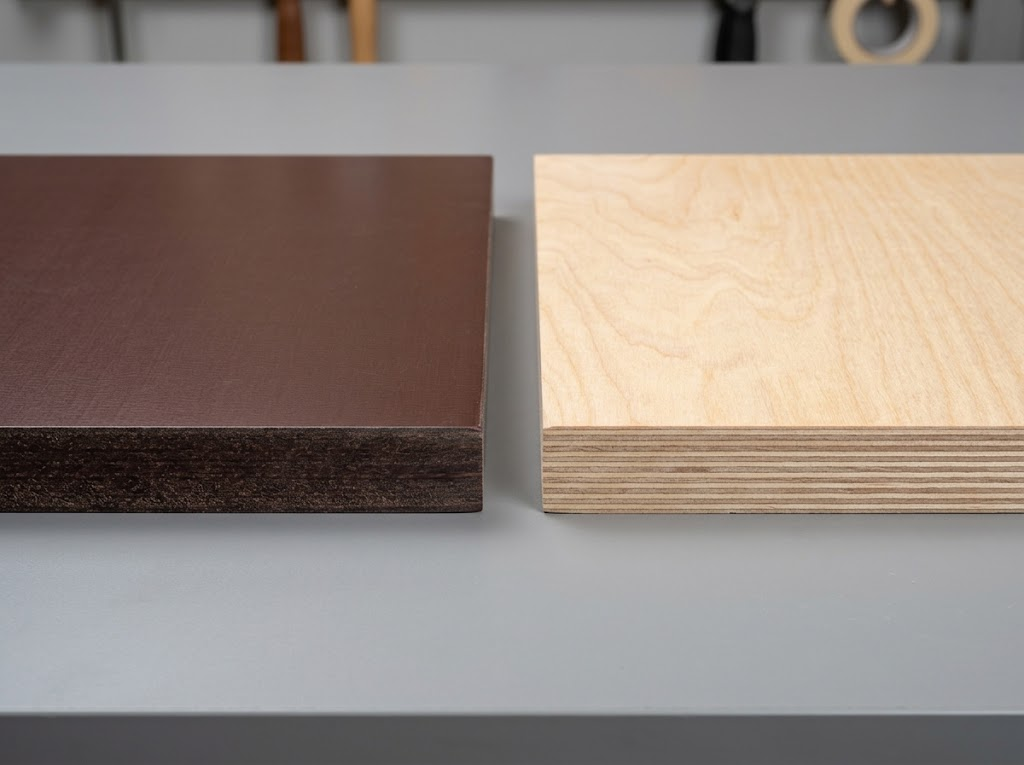
Plywood is made from several layers of thin wood veneers bonded together with alternating grain directions and compressed under pressure. This layered structure provides good strength for a wide range of general applications.
However, because plywood is made from natural wood, the material can absorb moisture more readily than non-wood-based panel materials. Its performance in humid environments therefore depends significantly on the type of plywood, surface treatment, edge protection, and installation conditions.
Phenolic Board Structure
Unlike plywood, phenolic board is manufactured from kraft paper compressed with phenolic resin under high pressure and temperature, as explained in the article Phenolic Board for Toilet Cubicles: Why Is It Widely Used in Commercial Buildings?.
This manufacturing process produces a dense, low-porosity panel with very low water absorption compared with conventional wood-based materials. This makes phenolic board particularly suitable for applications where resistance to moisture is an important requirement.
Moisture Resistance Comparison
In areas exposed to high humidity for extended periods, plywood can be susceptible to swelling, warping, or delamination between veneer layers, particularly when its protective surface or edge treatment is damaged or no longer effective.
Phenolic board, on the other hand, generally offers greater dimensional stability in humid environments because its resistance to moisture is an inherent characteristic of the panel structure rather than relying solely on a surface coating.
This makes phenolic board a practical choice for applications where the material may be regularly exposed to moisture or occasional water contact.
Fire Resistance Comparison
In addition to moisture resistance, fire performance can be an important consideration, particularly in commercial and public buildings.
Standard plywood is generally combustible and may require additional treatment or a fire-rated specification to meet specific fire safety requirements. Phenolic materials can offer better resistance to flame spread, depending on the product formulation and certified fire-performance rating.
For any project with specific fire-safety requirements, the actual product certification and applicable building standards should always be checked rather than relying solely on the material category.
Suitable Applications
Plywood remains a practical choice for dry or low-humidity areas, including interior furniture, cabinetry, decorative panels, and other general applications where direct water exposure is limited.
For areas with high humidity and intensive daily use, such as:
- Toilet cubicles
- Bathroom partitions
- Changing-room partitions
- Wet-area countertops
- Commercial and public facility interiors
phenolic board is generally a more suitable and durable option, as also discussed in the article Advantages of Phenolic Board as a Water- and Fire-Resistant Material.
For more information about related building material categories, visit the Batara Group product page.
Phenolic Board vs. Plywood: Which Should You Choose?
The choice between phenolic board and plywood ultimately depends on the environment, expected moisture exposure, frequency of use, and required durability.
For dry interior applications, plywood can be an economical and versatile solution. However, for humid environments where water resistance, dimensional stability, and long-term durability are key considerations, phenolic board generally offers significant advantages.
Choosing the right material based on the actual conditions of the application can help ensure better performance and a longer service life.