 Bahasa

How to Calculate Sealant Requirements for Construction Projects & Estimate Costs
For contractors and field applicators, running out of sealant in the middle of a project is a common problem that can delay progress. On the other hand, purchasing significantly more material than necessary can reduce the efficiency of your project budget and Bill of Quantities (BoQ).
Sealant quantity calculations are often underestimated and based only on visual estimates. However, sealant plays an important role as a waterproofing and sealing material, helping protect building components from water and air infiltration.
Instead of relying on guesswork, use the following practical guide to calculate your project’s sealant requirements more systematically and accurately.
Packaging Units and Coverage
Before starting the calculation, it is important to understand the common sealant packaging options available in the construction market. Sealants are generally available in several capacities:
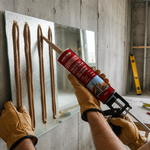
- Tube (Cartridge): The most common rigid cylindrical container, typically containing around 280 ml to 300 ml of sealant.
- Sausage (Foil): A flexible package resembling a sausage, commonly available in 600 ml sizes. This format is suitable for medium-scale industrial sealant applications.
- Drum/Pail: Available in larger capacities, such as 20 liters, and typically used for large-scale projects with mechanical dispensing equipment.
As a simple calculation example, one 300 ml sealant cartridge can produce approximately 3 meters of sealant joint when the applied sealant cross-section is 1 cm × 1 cm.
This is only a volume-based simulation. Actual coverage may vary depending on the joint dimensions and design, application method, tooling technique, and material losses during installation.
Sealant prices per cartridge can also vary depending on the product type, specifications, and brand. Therefore, when comparing prices, consider the package capacity and technical specifications, rather than looking only at the price per package.
Simple Formula for Calculating Sealant Requirements
To estimate the required amount of sealant, first calculate the sealant volume based on the joint length, width, and sealant depth. Then compare the calculated volume with the capacity of each package.
- Sealant volume formula: Joint Length × Joint Width × Sealant Depth
- Unit conversion: 1 ml = 1 cm³. Therefore, when dimensions are calculated in centimeters, the resulting volume in cm³ can be directly converted to milliliters using the same numerical value.
Scenario 1: Residential Window Joint
For example, you are installing an aluminum window frame in a house and need to seal the gap around the frame.
- Total window perimeter: 4 meters (400 cm)
- Joint dimensions: 1 cm wide × 1 cm deep
- Sealant volume: 400 × 1 × 1 = 400 cm³ (or 400 ml)
- Requirement: Approximately 1.3 cartridges of 300 ml each. Therefore, you would need to purchase 2 cartridges to ensure sufficient material on site.
Scenario 2: Metal Roof Joint
A warehouse roof repair project requires sealing a flashing joint with a total length of 15 meters (1,500 cm).
- Roof joint dimensions: 2 cm wide × 1 cm deep
- Sealant volume: 1,500 × 2 × 1 = 3,000 cm³ (3,000 ml)
- Requirement: If using 600 ml sausage packs, you would need 5 sausage packs based on the calculated volume.
Scenario 3: Large-Scale Warehouse Project
You need to seal expansion joints on exterior precast concrete wall panels with a total length of 200 meters (20,000 cm).
- Structural joint dimensions: 2 cm wide × 1.5 cm deep
- Total sealant volume: 20,000 × 2 × 1.5 = 60,000 cm³ (60 liters)
- Requirement: The project would require 100 sausage packs of 600 ml each based on the calculated volume. For projects of this scale, purchasing sealant in pail packaging may offer greater logistical and cost efficiency, depending on the product and dispensing system.
Tips to Minimize Sealant Waste on Site
The mathematical calculation above may not fully represent actual consumption if the application process is inefficient. Apply the following field practices to help minimize material waste:
- Use a Backer Rod: If the joint is too deep, install a cylindrical foam backer rod first. This helps control sealant depth and prevents unnecessary sealant from filling the entire depth of the joint.
- Cut the Nozzle to Match the Joint: Avoid cutting the applicator nozzle too wide. A nozzle cut at approximately 45 degrees can help provide more controlled sealant application along the joint.
- Use Masking Tape: Apply masking tape along both sides of the joint. This helps prevent excess sealant from spreading onto adjacent surfaces during tooling, reducing cleanup and material waste.
Consult Your Project Material Requirements
Accurate material planning can help maintain project cost efficiency and reduce the risk of supply shortages on site. For reliable sealing performance, consider using high-quality commercial-grade Sealant products suitable for your application.
Batara Group provides a range of trusted brands for professional construction requirements, including products from Viscous.
Expand your technical knowledge by reading our guide on How to Choose the Right Sealant for Different Materials and Applications and our introductory guide, Understanding Sealant: Functions, Types, and Applications in Construction.
Contact our technical team today to calculate your project’s sealant supply requirements and get a cost-efficient quotation tailored to your needs.