 Bahasa
Glasswool vs. Rockwool: How to Choose the Best Sound Insulation for Partition Walls
Noise from outdoor environments or between interior partitions is one of the biggest challenges in both residential and commercial building design. To minimize unwanted sound transmission, acoustic insulation systems rely on porous materials that effectively absorb sound vibrations and reduce noise transfer.
The two most widely used acoustic insulation materials in today's construction industry are glasswool and rockwool. Both are designed to improve Sound Transmission Class (STC) performance—the standard measurement of a material's ability to block airborne sound. However, they differ significantly in composition, density, temperature resistance, and overall performance.
What Is Glasswool?
Glasswool is a thermal and acoustic insulation material manufactured from recycled glass fibers and high-purity silica sand. These raw materials are melted at extremely high temperatures and spun into fine, lightweight fibers.
The microscopic glass fibers are bonded together using a specialized resin and formed into blankets or rolls. The air pockets trapped between the fibers absorb and dissipate sound waves, making glasswool highly effective for acoustic insulation.
Material Composition and Density
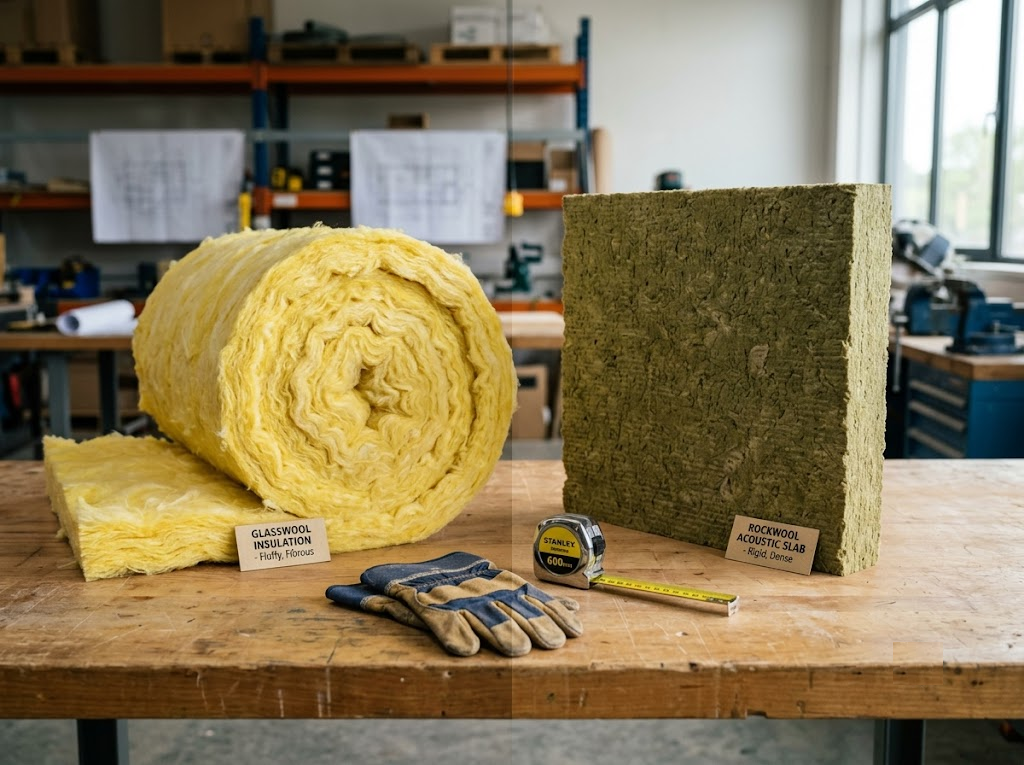
One of the defining characteristics of glasswool is its lightweight structure and flexibility. With a typical density ranging from 16 kg/m³ to 48 kg/m³, it is easy to cut, shape, and install within wall cavities, suspended ceilings, and HVAC systems.
Glasswool performs exceptionally well in absorbing mid- to high-frequency sound, making it ideal for reducing echoes and improving indoor acoustic comfort.
What Is Rockwool?
Rockwool, also known as mineral wool, is manufactured from volcanic rocks such as basalt and other natural minerals. These materials are melted at temperatures exceeding 1,500°C before being spun into dense mineral fibers.
Compared to glasswool, rockwool has a much higher density, typically ranging from 60 kg/m³ to over 120 kg/m³. This denser structure provides superior sound insulation while also offering exceptional fire resistance.
Thickness and Performance
Rockwool is widely recognized for its dual performance as both an acoustic insulation and a passive fire protection material.
Its dense fiber structure effectively blocks low-frequency noise, including machinery, mechanical equipment, and heavy traffic sounds. In addition, rockwool is classified as non-combustible, making it suitable for buildings that require high fire safety standards.
A standard thickness of 50 mm is generally sufficient for commercial partition walls requiring high acoustic performance.
Glasswool vs. Rockwool: Technical Comparison
For architects, engineers, contractors, and property developers, selecting the right insulation material should never be based solely on cost. The surrounding environmental conditions, fire safety requirements, and acoustic performance should all be carefully evaluated.
One of the most common issues found in construction projects is the use of unsuitable insulation materials in high-temperature environments, resulting in premature material degradation and reduced long-term performance.
Technical Comparison Table
| Technical Parameter | Glasswool | Rockwool |
|---|---|---|
| Base Material | Recycled Glass Fiber (Silica) | Basalt Mineral Fiber |
| Average Density | 16–48 kg/m³ | 60–120 kg/m³ |
| Maximum Service Temperature | Approximately 250°C–400°C | Approximately 850°C–1,000°C |
| Acoustic Performance | Excellent for medium and high frequencies | Excellent across low, medium, and high frequencies |
| Fire Performance | Fire-retardant | Non-combustible |
| Primary Applications | HVAC duct insulation, lightweight partitions, roof insulation | Fire-rated walls, partition systems, industrial facilities, server rooms |
Recommended Applications
Although both materials serve similar purposes, their physical properties and density make each one more suitable for specific applications.
When to Use Glasswool
Glasswool is commonly used for:
- HVAC duct insulation
- Residential ceiling insulation
- Lightweight partition walls
- Roof thermal insulation systems
- Areas where budget-friendly acoustic treatment is required
Its lightweight design makes installation easier while providing excellent thermal and acoustic performance in standard residential and commercial environments.
When to Use Rockwool
Rockwool is recommended for projects requiring maximum sound insulation and fire protection, including:
- Office partition walls
- Meeting rooms
- Recording studios
- Home theaters
- Factory walls
- Generator rooms
- Data centers and server rooms
- Buildings requiring fire-rated wall assemblies
Its higher density significantly improves STC ratings while providing superior passive fire protection.
Which Material Is Better for Partition Walls?
If your objective is to create partition walls with high acoustic privacy, such as conference rooms, cinemas, music studios, or office meeting spaces, rockwool is generally the better choice. Its dense mineral fiber structure provides superior sound blocking performance, especially for low-frequency noise.
On the other hand, if your primary goal is to reduce echoes or improve acoustic comfort in residential ceilings or standard partition systems, glasswool offers a more cost-effective solution without compromising performance for everyday applications.
Frequently Asked Questions (FAQ)
Is glasswool or rockwool waterproof?
No. Neither material is designed to withstand prolonged exposure to standing water. Excessive moisture can damage the internal fiber structure, reducing both thermal insulation and acoustic performance.
Are glasswool and rockwool fibers harmful during installation?
The fine fibers from both materials may cause temporary skin irritation and respiratory discomfort during handling. Installers should always wear appropriate personal protective equipment (PPE), including gloves, safety glasses, and a dust mask or respirator.
When should I choose rockwool instead of glasswool?
Rockwool is the preferred choice whenever a project requires both high-performance acoustic insulation and enhanced fire resistance. It is commonly specified for industrial facilities, mechanical rooms, server rooms, and fire-rated partition walls.
Consult the Right Insulation Solution for Your Project
Choosing the wrong insulation material can increase maintenance costs, reduce occupant comfort, and compromise building performance over time. Whether you're designing a residential property, commercial office, or industrial facility, selecting the appropriate acoustic insulation is essential for achieving long-term efficiency, safety, and comfort.
Contact the technical team at Batara Group to discuss the most suitable insulation specifications for your project and ensure your construction investment delivers optimal performance.